How to Get Static Out of Clothes in 2026 (Explained Simply)
Figuring out how to get static out of clothes is one of those small daily annoyances that somehow catches you at the worst possible moment. You pull a shirt from the dryer and it's stuck to your back, your skirt is clinging to your tights, or you're getting little zaps every time you touch a doorknob. The good news is that static on clothing is predictable, well understood, and genuinely fixable once you know what's actually causing it.
The core issue is simple: synthetic fabrics like polyester, nylon, and rayon build up electrical charge when they rub against other materials in the dryer or against your skin. Indoor humidity below 40% makes it significantly worse, which is why static peaks every winter when heating systems dry out the air. Let's walk through what works, what doesn't, and how to pick the right method for your situation.
Image source: Bing (Web (fair-use with source credit))
Quick Answer
Use an anti-static spray on dry clothes for instant relief. Add wool dryer balls to your laundry cycle to prevent static from building up. Keep indoor humidity between 40% and 50% to reduce static long-term.
For emergencies, a dampened hand or a metal hanger works in seconds.
What Causes Static in Clothes — And Why It's Worse Some Days
Static cling happens when electrons transfer between fabrics through friction, a process called triboelectric charging. Synthetic fibers like polyester and nylon are insulators, meaning they hold onto that charge instead of dissipating it. Natural fibers like cotton and linen generate far less static because they absorb moisture from the air, which helps conduct charge away.
The biggest environmental factor is humidity. When indoor relative humidity drops below 40%, static buildup increases dramatically. That's why you notice it most in winter, in arid climates like the Southwestern US, and in buildings with forced-air heating.
Airplane cabins are another notorious culprit, with humidity often sitting below 20%.
A few other things make static worse:
- Over-drying clothes in a high-heat dryer
- Washing synthetic fabrics together (more friction, more charge)
- Wearing multiple synthetic layers that rub against each other
- Low-moisture fabrics that have been line-dried in dry conditions
The American Association of Textile Chemists and Colorists (AATCC) has published testing standards for fabric static propensity, and their research confirms that fiber composition and ambient humidity are the two dominant variables. You can't change the fabric your clothes are made from, but you can absolutely control the environment and the treatment.
The Decision Guide: Which Method Fits Your Situation
Not every static problem calls for the same fix. Here's how to match the right solution to what you're dealing with right now.
You're already dressed and need static gone in 30 seconds
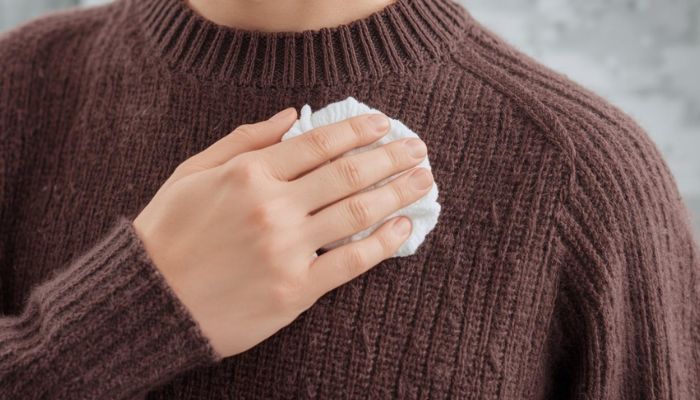
Run a dampened hand over the surface of the garment. Lightly mist the inside of the garment with water from a spray bottle. Slide a metal hanger between your skin and the fabric to discharge the charge instantly.
Rub a small amount of water-based lotion on your skin underneath the garment.
You're doing laundry and want to prevent static from forming
Add wool dryer balls to the dryer load. Pour a quarter cup of white vinegar into the fabric softener dispenser during the rinse cycle. Reduce dryer heat and remove clothes while they're still slightly damp.
Avoid overloading the dryer, which increases friction between garments.
You're traveling or don't have supplies on hand
Carry a small travel-size anti-static spray. Rub the garment with a damp paper towel or tissue. Smooth a tiny amount of hand lotion on your legs before putting on tights or skirts.
Run a wet hand over the fabric surface.
You're dealing with delicate or dry-clean-only fabrics
Use a targeted anti-static spray designed for delicates, tested on an inconspicuous area first. Hold a steam iron a few inches from the fabric and let the steam penetrate without touching. Hang the garment in a steamy bathroom for 10 to 15 minutes.
Avoid rubbing or brushing, which can generate more static on delicate fibers.
You want a long-term fix for a whole-house static problem
Run a humidifier in your main living spaces during winter months. Target indoor humidity between 40% and 50%, which is the range recommended by EPA indoor air quality guidelines. Switch to wool dryer balls as a permanent replacement for dryer sheets.
Choose natural fiber clothing where practical, especially for base layers.
Anti-Static Spray: How to Use It Without Ruining Your Outfit
Anti-static spray is the fastest reliable fix for static on dry clothes. Most commercial products work by depositing a thin layer of surfactant on the fabric surface, which attracts moisture from the air and allows charge to dissipate. The effect typically lasts between 1 and 24 hours depending on the product formulation and ambient humidity.
The key is application technique. Hold the can 8 to 12 inches from the garment and apply a light, even mist to the inside of the fabric. Don't saturate the material.
Overspraying can leave visible residue, especially on dark fabrics like black dresses or navy suits. If you're treating something you're already wearing, spray the inside surface where it won't be visible.
Image source: Wikimedia Commons / Pedro Ribeiro Simões from Lisboa, Portugal (CC BY)
A few things to watch out for:
- Aerosol propellants are flammable. Keep spray away from open flames and heat sources.
- Some formulas contain fragrance allergens. Check the label if you have sensitive skin.
- Spray in a well-ventilated area, especially with aerosol products.
- Test on an inconspicuous area of delicate fabrics before full application.
If you'd rather skip commercial products, a DIY version works reasonably well. Mix one part liquid fabric softener with eight parts water in a spray bottle. Shake before each use and apply the same way.
It's not as long-lasting as purpose-built anti-static spray, but it's effective for light static and costs almost nothing.
Dryer Sheets vs. Wool Dryer Balls: Which One Actually Wins
This is one of the most common debates in laundry care, and the answer depends on what you're optimizing for. Both reduce static, but they work through completely different mechanisms and come with different trade-offs.
Dryer sheets coat fabrics with a thin layer of lubricant and fragrance during the tumbling cycle. They're effective at reducing static on the first use, they smell good, and they cost roughly $0.03 to $0.10 per sheet depending on the brand. The downside is that the coating builds up over time, reduces the absorbency of towels, and introduces quaternary ammonium compounds into wastewater.
They're also single-use, which adds up over thousands of loads.
Wool dryer balls work mechanically. They bounce around in the dryer, separating fabric surfaces so they don't rub together and generate charge. They also absorb moisture and release it gradually, which helps maintain a slightly more humid micro-environment inside the drum.
Manufacturer specifications indicate they last for 1,000 or more loads, and aggregate reviews report a drying time reduction of roughly 10% to 25%.
Image source: Wikimedia Commons / Christine Rondeau (CC BY)
Here's a direct comparison:
| Factor | Dryer Sheets | Wool Dryer Balls |
|---|---|---|
| Static reduction effectiveness | Strong on first use | Moderate, consistent over time |
| Cost per load | $0.03–$0.10 | Under $0.01 (amortized) |
| Lifespan | Single use | 1,000+ loads |
| Fragrance | Yes (varies by product) | None (add essential oils if desired) |
| Impact on towel absorbency | Reduces over time | No impact |
| Environmental footprint | Single-use waste | Minimal, biodegradable |
| Best for | Scented loads, quick convenience | Long-term use, eco-conscious households |
Our research suggests wool dryer balls win for most people as of 2026. They're cheaper over time, they don't leave chemical residue, and they handle static prevention consistently across hundreds of loads. Dryer sheets still have a place if you want fragrance or if you're dealing with a particularly stubborn static load and need that extra coating effect.
For the best of both worlds, some people use wool dryer balls for most loads and keep dryer sheets on hand for heavy static situations like drying a full load of polyester bedding.
The Humidity Fix: Why Your Dry Air Is the Real Problem
If you only fix static at the garment level, you're treating the symptom. The root cause in most homes is indoor humidity that's too low. When relative humidity drops below 40%, synthetic fabrics generate and hold charge far more aggressively.
EPA indoor air quality guidelines recommend maintaining indoor humidity between 30% and 50%, with the 40% to 50% range being ideal for static prevention.
A humidifier is the single most effective long-term solution for households that deal with persistent static every winter. You don't need anything industrial. A standard bedroom-size humidifier with a 1 to 2 gallon tank capacity is enough to meaningfully raise humidity in a small room or apartment bedroom.
Larger living areas may require a console-style unit with higher output, measured in gallons per day.
Image source: Bing (Web (fair-use with source credit))
Placement matters. Put the humidifier in the room where you spend the most time getting dressed, since that's where you're dealing with static directly. Keep the door closed while it runs so the moisture doesn't migrate to other areas of the house.
Running it overnight is usually enough to maintain a stable humidity level through the next day.
A few important cautions:
- Clean the humidifier regularly. Standing water breeds bacteria and mold, which gets aerosolized into the air.
- Don't over-humidify. Relative humidity above 60% can promote mold growth on walls and windows.
- Use distilled or demineralized water if your tap water is hard. This reduces the white dust that some ultrasonic humidifiers produce.
- A simple hygrometer, available for under $10, lets you monitor actual humidity levels rather than guessing.
If you're in a rental or can't add a humidifier, hanging damp towels near heat sources or placing shallow water bowls near radiators can provide a modest boost. It's not as effective as a purpose-built humidifier, but it does help.
Methods That Barely Work (And Why People Still Recommend Them)
The internet is full of static remedies that sound clever but deliver inconsistent results. Here's what our research found about the most commonly shared ones.
The safety pin trick. Pinning a small metal safety pin to the inside of a garment does discharge some static through the metal. The effect is extremely localized though. It only works right where the pin touches, and it doesn't prevent static from building up elsewhere on the garment.
It's a minor help at best.
Aluminum foil balls in the dryer. Crumpling aluminum foil into a ball and tossing it in the dryer is supposed to reduce static by collecting charge. In practice, the foil ball doesn't make enough contact with enough fabric surface to make a meaningful difference. It also creates a fire risk if it works its way out of the dryer drum and contacts heating elements.
Rubbing dryer sheets on dry clothes. This works because you're transferring the same surfactant coating that a dryer sheet would deposit in the dryer. It's effective, but you're essentially using a dryer sheet in a less convenient way. If you're going to use one, just put it in the dryer where it does more good.
Hairspray on clothing. Some people spray hairspray on the inside of garments to reduce static. It does create a light coating that can reduce cling, but it's sticky, can stain fabrics, and isn't formulated for textile use. Anti-static spray exists for a reason.
Use that instead.
Grounding yourself by touching metal. This discharges the static on your body, which can help with shocks. It doesn't do anything for the static charge held in the fabric itself, so your clothes will still cling to you within minutes.
How to Keep Static From Coming Back All Winter
Static prevention is a system, not a one-time fix. If you want to stop fighting it every morning from November through March, build a routine that addresses the problem at every stage.
In the wash cycle:
- Add a quarter cup of white vinegar to the fabric softener dispenser. It naturally softens fibers without leaving a coating that builds up over time.
- Wash synthetic fabrics separately from natural fibers when possible. Mixing them in one load increases friction-driven charging.
- Don't overuse detergent. Excess soap that doesn't fully rinse out can leave residue that increases static.
In the dryer:
- Use at least three wool dryer balls per standard load. They separate fabric surfaces and reduce the friction that generates charge.
- Dry synthetic fabrics on a low-heat or permanent press setting. High heat dries fibers out more aggressively and increases static retention.
- Remove clothes while they're still slightly damp. Over-drying is one of the biggest drivers of static in machine-dried laundry.
In your home:
- Run a humidifier during heating season, targeting that 40% to 50% relative humidity range.
- Choose natural fiber base layers when you can. Cotton, wool, and linen under synthetic outer layers reduce the total charge buildup.
- Moisturize your skin. Dry skin against synthetic fabric increases static transfer. A light application of lotion before dressing helps.
When getting dressed:
- Keep a travel-size anti-static spray in your bag or at your desk for quick touch-ups.
- Dress in layers that mix natural and synthetic fibers rather than stacking multiple synthetics together.
- If a garment is clinging, run a damp hand over it before putting it on. It takes two seconds and works reliably.
What to Do When Nothing Else Works
Sometimes you've tried everything and static is still winning. Here's what to check and what to do next.
First, verify your actual indoor humidity with a hygrometer. Many people assume their home is humid enough when it's actually sitting at 25% or lower. If that's the case, a bigger humidifier or running your current one longer is the real fix.
Second, check your laundry routine. If you're using fabric softener on towels and athletic wear, that coating can actually increase static on certain synthetic blends over time. Switch to vinegar and wool dryer balls for those loads.
Third, consider the fabric itself. Some synthetic garments, especially older or lower-quality polyester, are so prone to static that no treatment fully solves the problem. If a particular item is a constant offender, replacing it with a natural fiber version may be the only permanent solution.
Fourth, look at your environment. If you work in a server room, a lab, or any space with industrial-grade air handling, the ambient humidity may be too low for consumer humidifiers to fully correct. In those cases, an ionizing anti-static gun, the kind used in electronics manufacturing, can discharge static on contact.
These devices emit a balanced stream of ions that neutralize charge on any surface. They're more expensive than household remedies, but they work on any fabric type in seconds.
Frequently Asked Questions
Can static damage my clothes?
Static itself doesn't damage fabric fibers. The charge buildup is a surface phenomenon and doesn't affect the structural integrity of the material. However, the dry conditions that cause static can make some fabrics feel stiffer or more brittle over time.
Why does static happen more in winter?
Indoor heating systems reduce relative humidity significantly. Cold air holds less moisture than warm air, and when you heat that cold indoor air, the relative humidity drops further. This creates the perfect environment for static buildup on synthetic fabrics.
Are anti-static sprays safe for all fabrics?
Most commercial anti-static sprays are safe for common fabrics like polyester, nylon, and cotton. Delicate fabrics like silk and rayon should be tested on an inconspicuous area first. Alcohol-based formulas can occasionally affect dyes on sensitive fabrics.
How long do wool dryer balls actually last?
Manufacturer specifications indicate a lifespan of 1,000 or more loads. Aggregate user reviews confirm they typically last several years with regular use. They'll eventually start to felt and lose some effectiveness, but they're far more durable than most people expect.
Does fabric softener reduce static?
Liquid fabric softener does reduce static by coating fibers with a lubricating layer. The trade-off is that this coating reduces absorbency and builds up over many wash cycles. White vinegar provides similar softening without the residue problem.
Can I use a dryer sheet and wool dryer balls together
You can, and some people do. The dryer sheet adds fragrance and extra coating while the dryer balls handle the mechanical separation. It's not necessary for static reduction, but it doesn't hurt anything either.
The Full Static-Free Laundry Routine
Here's a complete wash-day workflow that prevents static from forming in the first place.
- Sort fabrics. Wash synthetics separately from natural fibers to reduce friction-driven charging.
- Measure detergent carefully. Use the minimum effective amount. Excess soap leaves residue that increases static.
- Add vinegar. Pour a quarter cup of white vinegar into the fabric softener dispenser.
- Load wool dryer balls. Drop in at least three standard-size balls (2.5 to 3 inches diameter) per load.
- Select low heat. Use the permanent press or low-heat setting for synthetic fabrics.
- Remove clothes slightly damp. Stop the cycle 5 to 10 minutes early and let clothes finish air-drying on a rack.
- Hang or fold immediately. Letting clothes sit in a warm, dry pile allows static to build up again.
This routine takes the same amount of effort as your current process. You're just swapping a few steps that make a measurable difference in static reduction.