What Clothes Did People Wear in Ancient Egypt/history (2026)
When most people picture ancient Egypt, they imagine everyone wrapped in identical white sheets. That image is flat-out wrong. The reality of what clothes people wore in ancient Egypt is far more interesting, varied, and revealing about how that society actually worked.
Clothing signaled your rank, your job, your gender, and even your spiritual standing. A pharaoh's wardrobe looked nothing like a farmer's, and the differences were intentional.
Egyptian dress evolved across more than 3,000 years of pharaonic history. Garment styles shifted between the Old, Middle, and New Kingdoms. Materials ranged from coarse commoner linen to fabric so fine it was nearly transparent.
What you wore told everyone exactly where you stood. Let's break it down piece by piece.
Image source: Wikimedia Commons / Maler der Grabkammer des Userhêt (III)
Quick Answer: What Most People Get Wrong About Egyptian Dress
Ancient Egyptians primarily wore garments made from linen, woven from flax grown along the Nile. Men commonly wore wrapped lower garments like the shendyt (a kilt-like skirt) or schenti (a loincloth). Women wore the kalasiris, a fitted linen dress.
Social rank determined fabric fineness, garment length, and how much jewelry you could wear. Children under about six often wore nothing at all. Color was rare.
White dominated because it reflected heat and signaled cleanliness and status.
The Garments: Key Clothing Types From Pharaohs to Farmers
Egyptian clothing wasn't one-size-fits-all. The basic wardrobe changed depending on whether you were a nobleman, a scribe, a soldier, or a field worker. But a few core garments show up again and again in tomb paintings, surviving textiles, and archaeological records.
Shendyt and Schenti — The Wrapped Lower Garments
The shendyt was the workhorse garment for Egyptian men across most social classes. It was a rectangular piece of linen wrapped around the hips and tied or belted at the waist, falling anywhere from the upper thigh to below the knee. Think of it as a structured kilt rather than a loose skirt.
The length and quality of your shendyt said a lot about you. Pharaohs and high officials wore longer versions made from the finest, most finely pleated linen. Laborers and soldiers wore shorter, coarser versions that allowed freer movement.
The schenti was a simpler variant, basically a loincloth or wrapped cloth that served the same purpose for men doing heavy physical work.
These garments were practical. The wrapped construction meant you could adjust the fit without any tailoring. The linen breathed in extreme heat.
And the pleated versions held their shape beautifully, which tomb art confirms again and again.
Image source: Bing (Web (fair-use with source credit))
Kalasiris — The Fitted Linen Dress
The kalasiris was the standard garment for Egyptian women. It was a fitted linen dress, often depicted in tomb art as closely draped around the body, sometimes with one or two shoulder straps. Surviving examples and artistic representations suggest it ranged from ankle-length for elite women to calf-length for working women.
Here's where things get interesting. The famous "tight white dress" look you see in movies is partly based on real evidence. Some surviving linen garments from tomb finds are cut and sewn to follow the body's shape.
But many depictions in art are idealized. Real everyday kalasiris dresses were likely a bit looser and more practical than the painted versions suggest.
Elite women's kalasiris garments were made from the highest-grade linen, sometimes so fine it was semi-transparent. They were often layered with shawls or mantles. Working women wore simpler, sturdier versions.
The dress itself didn't change dramatically across the three kingdoms, but the accessories and fabric quality certainly did.
Shawls, Mantles, and Layered Wraps
Layering was a status move. Wealthier Egyptians added rectangular shawls or mantles over their basic garments. These were draped over one or both shoulders, sometimes wrapped around the torso, and could be adjusted for warmth during cooler desert nights.
The shawl was typically a large rectangle of linen, sometimes pleated, sometimes plain. High-status individuals are shown in tomb art with elaborately folded and draped shawls that would have required a servant to arrange properly. This wasn't just fashion.
It was a visible display of leisure and wealth.
During the New Kingdom, layering became more elaborate. Multiple sheer linen layers created a draped, almost sculptural effect that you can see clearly in depictions of Queen Nefertiti and other royal women. The fabric was so fine in these cases that it bordered on transparent, which was intentional and associated with divine radiance.
What Children and Laborers Actually Wore
Children in ancient Egypt typically wore nothing until around age six. This wasn't a sign of poverty. It was normal across all social classes.
Tomb art consistently shows young children nude, sometimes with a side-lock of hair to indicate their age.
Once children were old enough to wear clothing, they wore simplified versions of adult garments. Boys wore small shenti-style wraps. Girls wore miniature kalasiris dresses.
The fabric was coarser and the construction simpler than adult versions.
Laborers, soldiers, and field workers wore the most minimal clothing. Many are depicted in tomb art wearing just a short loincloth or sometimes working nude, particularly in hot conditions. This wasn't shameful.
It was practical. Heavy physical labor in 110°F heat doesn't call for layers.
Linen: The Fabric That Defined an Entire Civilization
You can't understand Egyptian clothing without understanding linen. It was the backbone of the entire textile tradition, and Egypt was famous for it across the ancient world.
How Flax Became Egypt's Most Important Textile
Flax (Linum usitatissimum) grew abundantly along the Nile, and Egyptians had been cultivating it for fiber since at least the Neolithic period. The process was labor-intensive. Flax stalks were pulled up by hand, retted (soaked) to separate the fibers, beaten to break down the woody core, then spun into thread on drop spindles.
The thread was woven on horizontal looms, typically by women, though professional male weavers also worked in temple and royal workshops. The quality of the finished linen varied enormously. Common-grade linen was coarse and slightly yellowish.
Royal-grade linen was bleached white and woven so finely that surviving examples have thread counts that rival modern high-end fabrics.
Wool was known but rarely used. It was considered ritually impure by some priestly classes. Animal fibers don't show up in elite burial contexts the way linen does.
Leather was used for sandals and some military gear, but not for everyday garments.
Why White Dominated — And When Color Appeared
White wasn't just a preference. It was practical and symbolic. White linen reflected sunlight, keeping the wearer cooler.
It showed cleanliness, which mattered in a culture that linked physical purity to spiritual purity. And bright white fabric was harder to produce, so it naturally became a status marker.
That said, color did appear. Saffron yellow, indigo blue, and madder red were used for decorative elements, borders, and some garments, particularly from the Middle Kingdom onward. Dyeing linen is harder than dyeing wool or cotton, which partly explains the limited color palette.
But colored threads were woven into borders, sashes, and decorative bands on elite garments.
The famous "Egyptian blue" pigment shows up in art but rarely in textiles. Most color in Egyptian clothing came through jewelry, beadwork, and accessories rather than dyed fabric itself.
Pleating, Weaving, and What Made Royal Linen Different
Pleating was a signature technique. Egyptian linen workers developed methods for creating sharp, permanent pleats in wet linen, then drying them in place. The result was fabric that held crisp, accordion-like folds.
This wasn't just decorative. Pleated linen allowed airflow while maintaining structure, which was ideal for the climate.
Royal and elite linen was in a different league from common grades. Tomb inventories describe linen in terms of fineness, whiteness, and origin. The finest grades came from royal workshops and were described with terms that translate roughly to "royal linen" or "fine transparent linen." Some surviving examples from the tomb of Tutankhamun are so finely woven they're almost gauze-like.
The Metropolitan Museum of Art holds Egyptian linen samples that demonstrate this range clearly. Coarse utility linen has visible slubs and uneven threads. Royal-grade linen is smooth, even, and remarkably thin.
The difference would have been obvious to anyone seeing it in person.
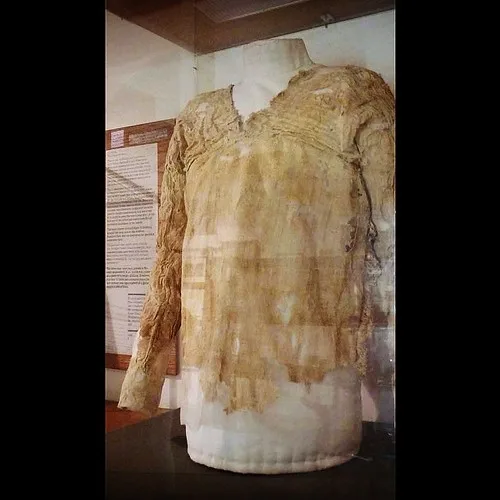
Image source: Openverse / akhenatenator
Wigs, Jewelry, and Adornment: The Other Half of Egyptian Dress
Clothing was only part of the picture. Egyptians invested enormous effort in wigs, jewelry, cosmetics, and accessories. These elements completed the visual identity that clothing started.
Wig Styles and What They Signaled
Most Egyptians shaved their heads. This was partly about hygiene in a hot climate, partly about preventing lice, and partly about wig culture. Wigs were worn by both men and women of status, and they came in distinct styles that changed over time.
The tripartite wig, with three sections of hair falling over the back and shoulders, was popular among elite men during the New Kingdom. Women often wore longer, heavier wigs with multiple braided sections. The Nubian wig, with tight, short curls, became fashionable during the 18th Dynasty.
Hathoric curls, long spiraling locks associated with the goddess Hathor, appeared on women's wigs in ceremonial contexts.
Wigs were made from human hair, plant fiber, or a combination. They were constructed on a mesh foundation, with individual hairs or fiber bundles knotted into place. Surviving examples from tombs show incredible craftsmanship.
Some wigs weighed several pounds and would have been hot to wear, which tells you how important the visual effect was.
Commoners who couldn't afford wigs often wore their natural hair short or shaved. The absence of a wig was itself a class marker.
The Usekh Collar and Broad Jewelry Traditions
The usekh collar, or broad collar, is one of the most iconic pieces of Egyptian jewelry. It was a wide, curved necklace made of multiple rows of beads, faience, gold, and semi-precious stones, resting across the chest and shoulders. Tutankhamun's broad collars are among the most famous surviving examples, with hundreds of individual components including lotus flowers, falcon heads, and djed pillars.
Broad collars weren't just decorative. They had protective and symbolic meanings, often associated with specific deities. The materials used, carnelian, turquoise, lapis lazuli, gold, and faience, each carried their own symbolic weight.
Beyond collars, Egyptians wore bracelets, anklets, earrings, and rings. Gold was the preferred metal for the elite. Faience, a glazed ceramic, was the affordable alternative that still looked striking.
Beaded net dresses, where thousands of beads were strung into a garment-shaped net worn over a linen dress, appear in burial contexts from the Old Kingdom onward.
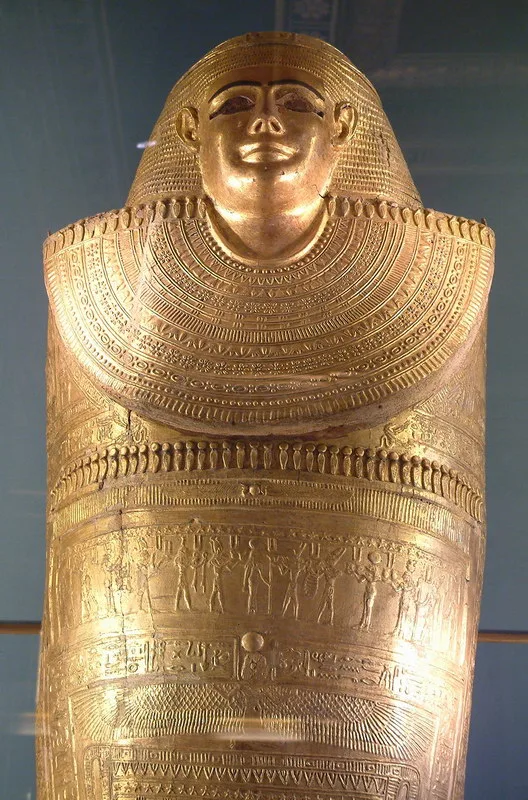
Image source: Wikimedia Commons / Unknown artistUnknown artist (CC BY-SA)
Sandals, Kohl, and Perfumed Cones
Sandals were the primary footwear. Most were made from woven papyrus or palm fiber. Leather sandals existed too, and some surviving examples from Tutankhamun's tomb are surprisingly elaborate, with gold leaf and decorative stitching.
Commoners often went barefoot, which tomb art confirms repeatedly.
Kohl eyeliner was standard for both men and women. It was made from galena (lead sulfide) or malachite, mixed with fat, and applied with a stick applicator. Beyond aesthetics, kohl may have offered some protection against eye infections and glare from the sun.
It was as much a health practice as a cosmetic one.
Perfumed fat cones are one of the more fascinating accessories. These were cones of solidified animal fat infused with aromatic resins or myrrh, placed on top of wigs during banquets and ceremonies. As the fat melted from body heat, it released fragrance and conditioned the wig.
They appear frequently in New Kingdom banquet scenes and have been found in archaeological contexts at Amarna.
How Clothing Changed Across the Old, Middle, and New Kingdoms
Egyptian fashion wasn't static. It shifted across the three major kingdoms, roughly spanning from 2686 BCE to 1069 BCE, with noticeable changes in silhouette, fabric treatment, and accessory complexity.
During the Old Kingdom (roughly 2686 to 2181 BCE), clothing was relatively simple. Men wore short shenty-style wraps. Women wore plain, close-fitting sheath dresses.
Linen was coarser by later standards. Jewelry existed but was less elaborate than what came later. The visual record from this period, mostly tomb reliefs at Giza and Saqqara, shows a clean, minimal aesthetic.
The Middle Kingdom (roughly 2055 to 1650 BCE) brought more variety. Garment lengths increased for the elite. More elaborate wrapping and draping styles appear in art.
Beaded girdles and decorative sashes became common. The first clear evidence of more complex pleating techniques dates to this period. Jewelry became more standardized in design, with distinct types of pectorals and collars appearing regularly.
The New Kingdom (roughly 1550 to 1069 BCE) was the golden age of Egyptian fashion. Linen reached its finest quality. Sheer, layered garments became fashionable among the elite.
Wigs became larger and more elaborate. The broad collar reached its most complex form. Foreign influence from Nubia, the Levant, and the Aegean introduced new motifs and techniques.
This is the period that most people picture when they think of Egyptian dress, and for good reason. It was the most visually spectacular era.
After the New Kingdom, during the Ptolemaic and Roman periods, Egyptian clothing increasingly blended with Greek and Roman styles. The traditional linen garments didn't disappear, but they coexisted with chitons, togas, and other Mediterranean fashions. That's a separate story, but it's worth knowing that "ancient Egyptian clothing" doesn't end with the pharaohs.
What Social Class, Gender, and Occupation Meant for What You Wore
Egyptian society was hierarchical, and clothing made that hierarchy visible. You could read someone's social position from across a room based on their garments, fabric quality, and accessories.
Pharaohs and the royal family wore the finest linen available, often semi-transparent and elaborately pleated. They wore gold jewelry, elaborate wigs, and ceremonial garments that had no practical purpose beyond display. The crook and flail, the nemes headdress, and the false beard were royal-specific items that had nothing to do with everyday clothing.
High officials and priests wore high-quality linen, though not quite at royal grade. Priests had specific ritual requirements. They had to wear pure white linen, shave their entire bodies, and avoid animal fibers.
These rules are documented in temple texts and were taken seriously.
Scribes and skilled workers wore decent-quality linen in practical lengths. Their clothing was functional but clean and well-maintained. A scribe's neat appearance reflected his educated status.
Farmers, fishermen, and laborers wore the coarsest linen, often just a short loincloth. Many worked partially or fully nude during hot periods. Their clothing was purely functional.
There's no evidence this carried any social stigma. It was simply practical.
Gender differences in clothing were less dramatic than you might expect. Both men and women wore wrapped linen garments. The main differences were in length, draping style, and accessories.
Women's garments tended to be longer and more closely fitted. Men's garments were often shorter and more loosely wrapped. But the basic material and construction were the same.
Occupation mattered too. Soldiers wore short, practical garments that allowed movement. Some wore leather or fabric chest protectors.
Priests wore specific ritual clothing. Dancers and entertainers wore minimal clothing or specialized performance garments, including beaded net dresses that were more decorative than modest.
How We Know What We Know: Tomb Art, Surviving Textiles, and Archaeology
Our understanding of Egyptian clothing comes from three main sources, and each has strengths and limitations.
Tomb paintings and reliefs are the most abundant source. They show people in their daily lives, at work, at banquets, and in ceremonial contexts. But they're idealized.
Artists depicted people at their best, in their finest clothes, often in poses that emphasize status and beauty rather than everyday reality. You can't take every painted garment as a literal photograph of what people wore on a Tuesday.
Surviving textiles are rarer but more reliable. Dry Egyptian tombs preserved linen remarkably well. Finds from sites like the Workmen's Village at Deir el-Medina and the tomb of Tutankhamun have given us actual garments to study.
These show real construction techniques, real fabric quality, and real wear patterns. The Griffith Institute at Oxford has documented many of these finds in detail.
Archaeological context fills in the gaps. Where textiles were found, what they were found with, and their condition all tell us about use and meaning. A linen sheet folded neatly in a tomb means something different than a worn-out loincloth discarded in a village midden.
Together, these sources give us a solid picture. But there are gaps. We have far more elite clothing than commoner clothing because elites were buried in conditions that preserved textiles.
The everyday garments of ordinary Egyptians are underrepresented in the archaeological record simply because they were worn out and discarded rather than preserved in tombs.
Common Misconceptions About Ancient Egyptian Clothing
Let's clear up a few things that pop up constantly in pop culture and casual writing about this topic.
"Everyone wore white robes." No. White was dominant, especially among the elite, but off-white, cream, and naturally tinted linen were common for everyday wear. And decorative elements, dyed borders, and colorful accessories added variety.
"All Egyptians wore the same thing." Absolutely not. Clothing varied by class, gender, occupation, and time period. A New Kingdom noblewoman's wardrobe was worlds apart from a Old Kingdom farmer's.
"Ancient Egyptians dressed modestly." Depends on your definition. Elite New Kingdom women are depicted in sheer, body-hugging linen that was deliberately revealing. Working men and children often wore very little.
Modesty standards were different from modern Western expectations.
"They wore sandals everywhere." Most commoners went barefoot. Sandals were a step up from nothing, and elaborate sandals were a status symbol. But bare feet were the norm for laborers and the poor.
"The clothing never changed." Three thousand years of history saw significant evolution. Comparing Old Kingdom dress to New Kingdom dress is like comparing medieval European clothing to Renaissance fashion. The basics were similar, but the details shifted considerably.
Egyptian Dress Compared to Mesopotamia, Greece, and Rome
Egypt didn't exist in a vacuum. Comparing its clothing traditions to neighboring cultures highlights what made Egyptian dress distinctive.
Mesopotamians relied heavily on wool. Their climate and available materials were different. Wool was dyed in bright colors and woven into patterned fabrics.
Egyptian linen, by contrast, was mostly undyed and valued for its natural whiteness. The two textile traditions were almost opposites in material and aesthetic.
Ancient Greeks wore the chiton and himation, draped wool or linen garments that share some structural similarities with Egyptian wrapped clothing. But Greek textiles were heavier, more colorful, and more structured. The Greek chiton was pinned at the shoulders.
Egyptian garments were wrapped and tied. The construction philosophy was different.
Romans adopted and adapted Greek clothing traditions. The toga was a uniquely Roman garment with no Egyptian equivalent. During the Ptolemaic period, when Greek and then Roman rulers controlled Egypt, clothing traditions blended.
Egyptian priests maintained traditional linen garments, but the broader population increasingly adopted Greco-Roman styles.
The key difference across all these comparisons is material. Egypt's commitment to linen, and its cultural resistance to wool and animal fibers in ritual contexts, set it apart from virtually every neighboring civilization. That single material choice shaped the entire visual identity of Egyptian dress.
Frequently Asked Questions
What was the most common fabric in ancient Egypt?
Linen, made from flax, was by far the most common fabric. It was worn by every social class, though quality varied enormously. Wool was known but rarely used, especially in religious contexts where it was considered impure.
Did ancient Egyptians wear colorful clothing?
Mostly no. White and off-white dominated, particularly among the elite. Color appeared in decorative borders, sashes, and accessories.
Dyeing linen is difficult, which limited the color palette compared to wool-based textile traditions.
What did Egyptian pharaohs wear?
Pharaohs wore the finest linen available, often semi-transparent and elaborately pleated. They wore gold jewelry, broad collars, elaborate wigs, and ceremonial items like the nemes headdress and false beard. Their clothing was designed for display, not practicality.
Did children in ancient Egypt wear clothes?
Children typically wore nothing until around age six. After that, they wore simplified versions of adult garments. Nudity in children was normal across all social classes and carried no stigma.
How did Egyptian clothing differ between social classes?
Elite Egyptians wore fine, white, often pleated linen with elaborate jewelry and wigs. Commoners wore coarser, undyed linen in simpler cuts. Laborers often wore just a loincloth or worked barefoot and partially nude.
Fabric quality, garment length, and accessories were the main class markers.
What did ancient Egyptian women wear?
Women primarily wore the kalasiris, a fitted linen dress ranging from ankle-length for elites to calf-length for working women. They layered shawls and mantles over the dress and wore elaborate jewelry, wigs, and cosmetics.
How We Know What We Know: Tomb Art, Surviving Textiles, and Archaeology
Our picture of Egyptian clothing rests on three pillars, and each one has blind spots you should understand.
Tomb paintings and carved reliefs are the most visible source. They show banquets, farming, fishing, and daily life in vivid detail. But artists weren't photographers.
They depicted people at their idealized best, in their finest clothes, arranged to show status and divine favor. A tomb painting of a nobleman doesn't show what he wore to weed his garden.
Surviving textiles are harder to find but more trustworthy. Egypt's dry tombs preserved linen for thousands of years. Finds from the Workmen's Village at Deir el-Medina and from Tutankhamun's tomb have given us actual garments.
These show real stitching, real fabric weight, and real wear patterns. The Griffith Institute at Oxford has catalogued many of these pieces, and the British Museum holds significant textile collections as well.
Archaeological context ties it all together. Where a textile was found, what it was buried with, and its condition all reveal how it was used. A neatly folded linen sheet in a royal tomb means something different than a worn-out loincloth tossed in a village refuse pit.
The problem is bias. Elite burials preserved clothing far better than commoner graves. We know far more about what wealthy Egyptians wore than what ordinary people had on.
Common Misconceptions About Ancient Egyptian Clothing
Pop culture has flattened Egyptian dress into a few tired images. Let's correct the biggest ones.
"Everyone wore identical white robes." Wrong. Fabric quality, garment length, draping style, and accessories varied enormously by class and period. A New Kingdom queen's sheer, pleated linen looked nothing like a farmer's coarse wrap.
"All Egyptians dressed the same regardless of era." Three thousand years of history saw real fashion shifts. Old Kingdom dress was simple and functional. New Kingdom dress was elaborate, layered, and deliberately sensual by comparison.
"They were always fully covered." Elite New Kingdom women are shown in body-hugging, semi-transparent linen. Laborers and children often wore minimal clothing or nothing at all. Coverage wasn't a universal value.
"Sandals were universal." Most commoners went barefoot. Sandals were a step up, and decorated sandals were a luxury item. Bare feet were the norm for anyone doing hard physical work.
"Clothing was purely practical." It was also deeply symbolic. White linen signaled ritual purity. Specific wig styles marked ceremonial roles.
Jewelry carried protective and religious meanings. Every garment was a communication device.
Egyptian Dress Compared to Mesopotamia, Greece, and Rome
Egypt didn't develop its clothing traditions in isolation. Comparing it to neighboring cultures shows what made it distinctive.
Mesopotamia relied on wool. The climate and available animals made wool the default textile. Mesopotamians dyed wool in bright colors and wove complex patterns.
Egyptian linen culture was almost the opposite. Undyed, white, and valued for its natural qualities rather than applied decoration.
Ancient Greece used both wool and linen. The chiton and himation were draped garments that share some structural DNA with Egyptian wrapped clothing. But Greek textiles were heavier and more colorful.
The Greek chiton was pinned at the shoulders with fibulae. Egyptian garments were wrapped and tied. Different construction philosophy, different visual result.
Rome inherited Greek traditions and added its own layers. The toga had no Egyptian equivalent. During the Ptolemaic period, Greek and Roman rulers brought their clothing customs into Egypt.
Egyptian priests kept wearing traditional linen, but the broader population increasingly adopted Greco-Roman styles. By the Roman period, traditional Egyptian dress was becoming a cultural marker rather than everyday wear.
The thread that sets Egypt apart is material commitment. Egypt's near-exclusive reliance on linen, and its cultural resistance to animal fibers in sacred contexts, made its clothing tradition unique in the ancient Mediterranean world.
Frequently Asked Questions
What was the most common fabric in ancient Egypt?
Linen, woven from flax, was the dominant fabric across all social classes. Quality ranged from coarse utility grades to royal linen so fine it was nearly transparent. Wool existed but was rarely used, especially in religious settings where it was considered ritually impure.
Did ancient Egyptians wear colorful clothing?
Mostly no. White and off-white dominated, particularly for elite garments. Color appeared in decorative borders, sashes, and accessories.
Dyeing linen is technically difficult, which limited the palette compared to wool-based traditions in Mesopotamia and Greece.
What did Egyptian pharaohs wear?
Pharaohs wore the finest linen available, often semi-transparent and elaborately pleated. They wore gold jewelry, broad collars, elaborate wigs, and ceremonial items like the nemes headdress and false beard. Their clothing was designed for display and ritual, not practicality.
Did children in ancient Egypt wear clothes?
Children typically wore nothing until around age six. After that, they wore simplified versions of adult garments. Nudity in children was normal across all social classes and carried no stigma whatsoever.
How did Egyptian clothing differ between social classes?
Elite Egyptians wore fine, white, often pleated linen with elaborate jewelry and wigs. Commoners wore coarser, undyed linen in simpler cuts. Laborers often wore just a loincloth or worked barefoot.
Fabric quality, garment length, and accessories were the primary class markers.
What did ancient Egyptian women wear?
Women primarily wore the kalasiris, a fitted linen dress ranging from ankle-length for elites to calf-length for working women. They layered shawls and mantles over the dress and wore elaborate jewelry, wigs, and cosmetics like kohl eyeliner.
How We Know What We Know: Tomb Art, Surviving Textiles, and Archaeology
Our understanding of Egyptian clothing comes from three source types, each with real strengths and real gaps.
Tomb paintings and reliefs are the most abundant. They show daily life, banquets, farming, and ceremonies in remarkable detail. But artists worked from convention, not observation.
People are shown at their idealized best. You can't treat a tomb painting like a photograph of a regular Tuesday.
Surviving textiles are rarer but more reliable. Dry Egyptian tombs preserved linen for millennia. Finds from Deir el-Medina and Tutankhamun's tomb have given us actual garments to study.
The Griffith Institute at Oxford and the British Museum have both catalogued significant textile collections that show real construction techniques and fabric quality.
Archaeological context fills the gaps. Where a textile was found, what accompanied it, and its condition all reveal how it was used. The problem is preservation bias.
Elite tombs protected clothing far better than commoner graves. We simply know more about what wealthy Egyptians wore.
Common Misconceptions About Ancient Egyptian Clothing
Pop culture has flattened Egyptian dress into a handful of clichés. Here are the biggest ones worth correcting.
"Everyone wore identical white robes." Fabric quality, garment length, and accessories varied enormously by class and period. A New Kingdom queen's sheer pleated linen looked nothing like a farmer's coarse wrap.
"All Egyptians dressed the same across history." Three thousand years of pharaonic rule saw real fashion evolution. Old Kingdom dress was simple. New Kingdom dress was elaborate, layered, and deliberately sensual.
"They were always fully covered." Elite women are depicted in body-hugging, semi-transparent linen. Laborers and children often wore very little. Coverage standards were not what modern audiences assume.
"Sandals were universal." Most commoners went barefoot. Sandals were a step up, and decorated sandals were a luxury. Bare feet were standard for physical labor.
"Clothing was purely functional." Every garment communicated status, role, and spiritual standing. White linen signaled ritual purity. Jewelry carried protective meanings.
Nothing was accidental.
Egyptian Dress Compared to Mesopotamia, Greece, and Rome
Comparing Egypt to its neighbors highlights what made its clothing tradition distinctive.
Mesopotamia relied on wool. Bright colors and woven patterns were the norm. Egypt went the opposite direction with undyed linen valued for its natural whiteness.
Greece used wool and linen in draped garments like the chiton. But Greek textiles were heavier and more colorful. Construction differed too.
Greek garments were pinned. Egyptian ones were wrapped and tied.
Rome inherited Greek traditions and added the toga. During the Ptolemaic period, Greek and Roman styles blended into Egyptian dress. Priests kept wearing traditional linen.
Everyone else increasingly adopted Mediterranean fashions.
Egypt's near-exclusive commitment to linen, and its ritual avoidance of animal fibers, made it unique in the ancient world.
Frequently Asked Questions
What was the most common fabric in ancient Egypt?
Linen from flax was the dominant fabric at every social class. Quality ranged from coarse utility grades to royal linen so fine it was nearly transparent.
Did ancient Egyptians wear colorful clothing?
White and off-white dominated. Color appeared in borders, sashes, and accessories. Dyeing linen is difficult, which limited the palette.
What did Egyptian pharaohs wear?
The finest linen available, often semi-transparent and elaborately pleated. Gold jewelry, broad collars, elaborate wigs, and ceremonial items like the nemes headdress completed the look.
Did children in ancient Egypt wear clothes?
Children typically wore nothing until around age six. Nudity in children was normal across all classes and carried no stigma.
How did Egyptian clothing differ between social classes?
Elites wore fine white pleated linen with jewelry and wigs. Commoners wore coarser, undyed linen in simpler cuts. Laborers often wore just a loincloth or went barefoot.
What did ancient Egyptian women wear?
The kalasiris, a fitted linen dress ranging from ankle to calf length. Layered with shawls, accessorized with jewelry, wigs, and kohl eyeliner.