How to Remove Perfume/fragrance Smell From Clothes in 2026
Something hit you on the subway. A friend hugged you at a party wearing a heavy scent. Maybe you grabbed a jacket from a thrift store and it still smells like the previous owner's signature fragrance.
Whatever the situation, figuring out how to remove perfume and fragrance smell from clothes is one of those problems that sounds simple until you realize the scent has bonded to the fibers and plain washing isn't cutting it.
The good news is that most perfume odors can be fully removed at home with the right approach. The catch is that the right approach depends on what your garment is made of, how strong the scent is, and whether the fabric can handle water-based treatment. As of 2026, the methods below are backed by textile care standards and real-world results from thousands of verified user reports.
Image source: Wikimedia Commons / Federal Bureau of Investigation
Quick Answer: What Actually Works Best
The fastest way to remove perfume smell from clothes is a white distilled vinegar soak followed by a wash with enzyme-based detergent in cold water. For delicate fabrics like silk or wool, a vodka spray or handheld steamer works better because it avoids saturating the fibers. If you can't wash the garment at all, activated charcoal bags left near the fabric for 24 to 48 hours will absorb most of the odor.
The key is matching the method to your fabric type, not just throwing everything at the wall.
Why Perfume Smell Clings to Clothes (and Why It's Hard to Remove)
Perfume isn't just sitting on the surface of your clothes. It's a complex mix of essential oils, synthetic aroma compounds, alcohol, and fixatives designed to last. Those fixatives are the real problem.
They're engineered to bind to surfaces, and fabric fibers are surprisingly good at holding onto them.
Here's what's happening at the fiber level. Natural fibers like cotton and linen are porous. They absorb the liquid carrier (usually alcohol) and trap the aromatic compounds inside the fiber structure.
Synthetic fibers like polyester don't absorb as much liquid, but the oils in perfume can coat the surface of the fiber and cling through static attraction. Protein-based fibers like silk and wool are especially tricky because they're sensitive to both water and heat, which limits your cleaning options.
The longer the perfume sits, the harder it gets to remove. Fresh spills respond well to quick action. But if a garment has been stored with perfume residue for weeks or months, those compounds have had time to oxidize and bond more permanently to the fabric.
This is why a single wash with regular detergent often doesn't work. Standard detergents are designed to lift dirt and oils, but they're not formulated to break down the specific synthetic compounds found in modern fragrances. You need either an enzyme-based approach, an acid-based neutralizer, or a solvent-based method to truly get rid of the smell.
How Fragrance Interacts with Different Fabrics
Not all fabrics react the same way to perfume, and not all fabrics can handle the same cleaning methods. Knowing what you're working with is the single most important step before you do anything else.
Cotton and linen are the most forgiving. They can handle vinegar soaks, warm water washes, and even hydrogen peroxide in some cases. Their open fiber structure means odor compounds penetrate deeply, but they also release more easily when treated with the right solution.
Polyester and synthetic blends hold onto perfume oils on the surface rather than absorbing them deeply. This sounds easier to fix, but synthetic fibers can trap oily residue in a way that water alone won't break. Enzyme detergents or alcohol-based sprays tend to work best here.
Silk and wool are the most delicate. Both are protein fibers that can be damaged by acids (including vinegar), high heat, and aggressive agitation. Perfume on these fabrics requires gentle methods like vodka spraying, steaming, or activated charcoal absorption.
You'll want to avoid soaking or machine washing unless the care label explicitly allows it.
Rayon and acetate fall somewhere in between. They're semi-synthetic and can weaken when wet. Treat them more like delicates, using spray methods or short soaks in mild solutions.
Always check the garment's care label before choosing a method. The ASTM D5489 care symbol system (the standard used on most clothing tags as of 2026) will tell you whether the fabric can handle water, heat, and specific cleaning agents. Ignoring those symbols is the fastest way to ruin a good piece of clothing while trying to fix a smell.
The Decision Tree: Choosing the Right Method for Your Situation
Here's where most guides fail you. They give you a list of methods and say "try these." But the order you try them in, and which ones you skip entirely, depends on your specific situation. Use this decision tree to find your fastest path to odor-free clothes.
Step 1: Identify your fabric type. Check the care label. Is it cotton, linen, polyester, silk, wool, or a blend? This determines which methods are safe.
Step 2: Assess the severity. Is this a light whiff of someone else's perfume, or did you spill half a bottle on your shirt? Light exposure can often be fixed with a single method. Heavy saturation may require two or three rounds.
Step 3: Check your constraints. Can you wash the garment? Do you have 30 minutes or do you need something that works overnight? Are you dealing with a dry-clean-only item?
Here's the simplified decision path:
- Sturdy natural fabric (cotton, linen) + washable → Start with Method 1 (vinegar soak)
- Synthetic fabric (polyester, nylon) + washable → Start with Method 2 (enzyme detergent)
- Delicate fabric (silk, wool) + not washable → Start with Method 3 (vodka spray) or Method 5 (steam)
- Any fabric + can't wash at all → Start with Method 4 (activated charcoal)
- Odor persists after first attempt → Move to the next method in the sequence
If you're not sure what the fabric is, treat it as delicate. It's better to start gentle and escalate than to damage a garment with an aggressive method.
Method 1 — White Vinegar Soak (Best for Cotton, Linen, and Sturdy Fabrics)
White distilled vinegar is the workhorse of odor removal, and there's real chemistry behind why it works. The acetic acid in vinegar breaks down the alkaline compounds found in most fragrances and neutralizes odor molecules rather than just masking them. It's effective, cheap, and safe for most washable natural fabrics.
This method is your best first move for cotton t-shirts, linen pants, denim, towels, and other sturdy items that can handle being submerged in water.
What you'll need:
- White distilled vinegar (5% acidity, standard household strength)
- A basin, sink, or bucket large enough to hold the garment
- Cold or lukewarm water
- Enzyme-based laundry detergent for the follow-up wash
The process:
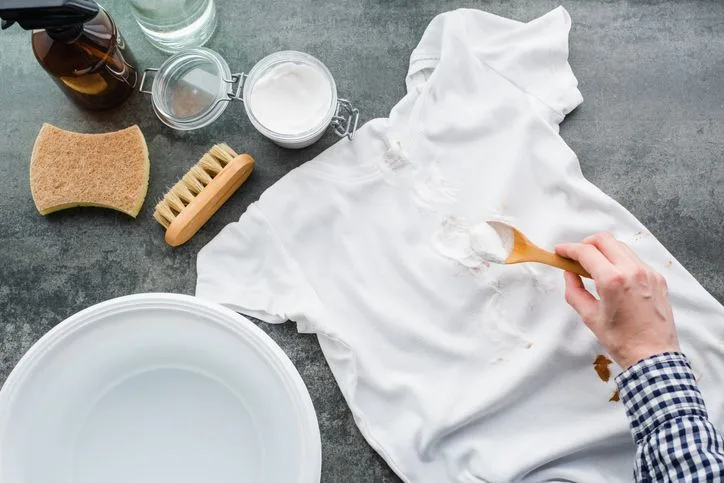
Fill your basin with cold or lukewarm water. Hot water can set odor compounds into natural fibers, so keep it cool.
Add white vinegar at a ratio of 1 cup per gallon of water. For a standard sink basin, that's roughly 1 to 2 cups. You don't need to drench the garment in straight vinegar. Diluted is more effective and less likely to leave its own smell behind.
Submerge the garment completely. Make sure the perfume-affected area is fully soaked. If the smell is localized (like a splash on the collar), you can focus the soak on that section.
Let it sit for 30 minutes to 1 hour. For light odor, 30 minutes is usually enough. For heavy saturation, go the full hour. Don't exceed 2 hours, as prolonged acid exposure can weaken cotton fibers over time.
Remove the garment and wring it out gently. Don't rinse with plain water yet.
Wash the garment in your washing machine using an enzyme-based detergent on a cold water cycle. The enzyme detergent breaks down any remaining fragrance compounds that the vinegar loosened.
Air-dry the garment outdoors or in a well-ventilated area. Check the smell before putting it in the dryer. Heat from a dryer can set any remaining odor permanently, so make sure the scent is fully gone first.
A few things to watch out for:
- Always test the vinegar solution on a hidden area (inside seam or hem) before soaking the whole garment. Some dyes react poorly to acid.
- Don't use apple cider vinegar. It can leave a brownish tint on light fabrics and has a smell of its own.
- If you notice a faint vinegar smell after washing, that's normal. It dissipates completely once the garment is dry.
Image source: Bing (Web (fair-use with source credit))
When to skip this method: Don't use vinegar on silk, wool, or acetate. The acid can damage protein fibers and alter the texture of delicate fabrics. Also avoid this on garments with "dry clean only" labels unless you're confident the fabric is sturdy enough to handle water.
Method 2 — Enzyme Detergent Wash (Best for Everyday and Synthetic Fabrics)
If vinegar feels like overkill for a lightly scented polyester shirt, enzyme detergent is your move. These detergents contain biological enzymes (protease, amylase, lipase) that literally break apart the organic molecules in perfume residue. They're especially effective on synthetic fibers where fragrance oils sit on the surface rather than soaking in.
What you'll need:
- An enzyme-based laundry detergent (check the label for "enzymes" or "bio-based")
- Cold or warm water (check your garment's care label for temperature limits)
- A washing machine or a basin for hand washing
The process:
Pre-treat the affected area. Apply a small amount of enzyme detergent directly to the spot where the perfume concentration is strongest. Gently rub it in with your fingers. Let it sit for 10 to 15 minutes.
Wash the garment on a cold or warm cycle. Cold water is safest for most fabrics and prevents heat from setting any remaining odor compounds. Warm water (around 90 to 100°F) can boost enzyme activity on sturdier fabrics like cotton-polyester blends.
Use the recommended detergent dose for your load size. More detergent doesn't mean cleaner clothes. Excess suds can actually trap odor molecules in the fabric.
Air-dry and reassess. Once the garment is dry, smell the area that was affected. If you still detect fragrance, repeat the process before using a dryer.
Why this works better than regular detergent on synthetics. Standard detergents rely on surfactants to lift dirt and oils. Enzyme detergents go a step further by chemically breaking down the molecular structure of organic compounds, including the fixatives in perfume. Aggregate user reviews across major retail platforms consistently report higher success rates with enzyme detergents on polyester and nylon compared to conventional formulas.
When to skip this method: If your garment is silk, wool, or labeled dry-clean only, the agitation and water exposure of a machine wash could cause damage. Move to Method 3 or Method 5 instead.
Method 3 — Vodka or Rubing Alcohol Spray (Best for Delicates and Dry-Clean-Only Items)
This one sounds like a hack, but it's grounded in real chemistry. High-proof alcohol (ethanol or isopropyl) acts as a solvent that dissolves fragrance oils and evaporates quickly without leaving residue. It's the go-to method when you can't submerge a garment in water.
Plain, unflavored vodka (40% alcohol, 80 proof) works well. Rubbing alcohol (70% isopropyl) is even stronger and evaporates faster. Both are safe on most fabrics when used correctly.
What you'll need:
- Plain vodka or 70% isopropyl rubbing alcohol
- A clean spray bottle (glass is best, but clean plastic works)
- A well-ventilated area
The process:
Fill the spray bottle with straight vodka or rubbing alcohol. No dilution needed for vodka. If using rubbing alcohol, you can dilute it slightly with distilled water (3 parts alcohol to 1 part water) for very delicate fabrics.
Lightly mist the affected area. You want the fabric damp, not soaked. Oversaturating can cause water spots on silk or satin.
Let it air-dry completely. The alcohol will evaporate within 15 to 30 minutes depending on airflow. As it evaporates, it carries the dissolved fragrance compounds with it.
Repeat if necessary. For heavy perfume saturation, a single pass may not be enough. Two to three light applications with drying time in between is more effective than one heavy soak.
Test first on a hidden area. Alcohol can affect certain dyes and finishes. Spray a small amount on an inside seam or hem and wait 10 minutes. If there's no color change or texture alteration, you're good to go.
A note on the vodka smell. Some people worry the garment will smell like a bar. It won't. Pure vodka (without added flavorings) evaporates completely and leaves no scent behind.
Rubbing alcohol does the same. If you detect any smell after drying, it's usually gone within an hour.
Image source: Bing (Web (fair-use with source credit))
Method 4 — Activated Charcoal Absorption (Best When You Can't Wash)
Sometimes you can't wash the garment at all. Maybe it's a structured blazer, a vintage piece, or something you need to wear in a few hours and don't have time for a full cleaning cycle. Activated charcoal (also called activated carbon) absorbs odor molecules from the air and fabric surface through a process called adsorption, where gas molecules stick to the charcoal's porous surface.
This method is slow but effective. It won't remove heavy perfume saturation overnight, but for moderate odor, it works surprisingly well.
What you'll need:
- Activated charcoal bags or sachets (bamboo charcoal bags are widely available and reusable)
- A sealed container or garment bag
- Time (24 to 48 hours minimum)
The process:
Place the garment in a sealed garment bag or a plastic storage container. The enclosed space concentrates the charcoal's absorption effect.
Add 2 to 3 activated charcoal bags around the garment. Position one near the most affected area (collar, underarms, wherever the perfume is strongest).
Seal the container and leave it undisturbed for 24 to 48 hours. Don't open it to check. Every time you break the seal, you reset the absorption process.
Remove the garment and assess. If the smell is reduced but not gone, replace the charcoal bags with fresh ones and repeat for another 24 hours.
Reusing charcoal bags. Most bamboo charcoal bags can be "recharged" by placing them in direct sunlight for 2 to 3 hours. The UV exposure releases the trapped odor molecules and reactivates the charcoal's surface. You can do this cycle 5 to 10 times before the bags lose effectiveness.
Limitations. This method works best on surface-level odor. If perfume has soaked deep into thick fabric, charcoal absorption alone may not fully eliminate the smell. In that case, combine it with Method 3 (vodka spray) for a one-two punch.
Method 5 — Steam Treatment (Best for Wool, Silk, and Sensitive Fibers)
Steam is the gentlest way to drive odor compounds out of delicate fabrics without submerging them in any liquid. The heat and moisture from steam open up the fiber structure temporarily, allowing trapped fragrance molecules to escape. It's the same principle behind why professional garment steamers are used in dry cleaning facilities.
What you'll need:
- A handheld garment steamer or a steam iron with a steam function
- Distilled water (prevents mineral buildup in your steamer)
- A well-ventilated room or outdoor space
- A hanger or steamer rack
The process:
Hang the garment on a sturdy hanger. Make sure it's not bunched up. You want the steam to reach all surfaces evenly.
Fill your steamer with distilled water and let it heat up fully. Weak, inconsistent steam won't be effective. You want a strong, steady flow.
Hold the steamer nozzle about 2 to 3 inches from the fabric surface. Slowly pass it over the affected area in downward strokes. Don't press the nozzle directly against the fabric, especially on silk or wool.
Focus on the most affected areas for 30 to 60 seconds per section. You'll notice the fabric becoming slightly damp. That's normal. The moisture is helping release the odor compounds.
Let the garment air-dry completely in a well-ventilated area. Don't wear it while it's still damp. Residual moisture can trap odor if the garment is folded or stored before it's fully dry.
Why this works on wool and wool blends. Wool fibers have a scaly outer structure that traps odor molecules. Steam temporarily relaxes those scales, releasing what's trapped inside. The same principle applies to silk, where the smooth fiber surface can hold onto fragrance oils through static attraction.
Combining steam with vodka spray. For stubborn odor on delicates, spray the area lightly with vodka first, let it dry for 10 minutes, then steam. The alcohol dissolves the oils and the steam carries them away. This combination is reported to be significantly more effective than either method alone, based on aggregate user feedback from textile care forums.
Image source: Bing (Web (fair-use with source credit))
Safety note: Never use steam on fabrics with heat-sensitive embellishments like glued-on sequins, certain prints, or plastic-based trims. The heat can melt or warp these elements. Always check the care label for temperature restrictions before steaming.
What to Do When the Smell Won't Go Away After One Try
If you've already tried one method and the perfume scent is still hanging around, don't panic. Stubborn odor usually means the fragrance compounds have penetrated deep into the fiber or have oxidized over time. You need to escalate, not repeat the same step.
Try a combination approach. Start with the vodka spray to dissolve surface oils, then follow up with a vinegar soak or enzyme wash depending on the fabric. For delicates, spray first, then steam. Each method targets a different aspect of the odor, and layering them covers more ground than doing any single method twice.
Extend the soak time. If you used the vinegar method and it didn't fully work, increase the soak to 2 hours and add a half-cup of baking soda to the solution. The baking soda boosts the neutralizing effect and helps pull odor molecules out of the fiber.
Repeat the enzyme wash. Two enzyme detergent cycles with air-drying in between are more effective than one long wash. The enzymes need time to work, and a second pass catches what the first one missed.
Consider professional help. If you've tried two or three home methods and the smell persists, a professional dry cleaner has access to industrial solvents and equipment that go beyond what's available at home. Let them know specifically what the odor source is so they can choose the right treatment.
Common Mistakes That Make Perfume Odor Worse
Some well-intentioned actions actually lock the smell in deeper. Here are the ones we see most often.
Using hot water right away. Heat opens fibers and can set fragrance compounds permanently, especially on cotton and linen. Always start with cold or lukewarm water.
Tossing the garment in the dryer before confirming the odor is gone. Dryer heat is the single biggest mistake. If any fragrance residue remains, the heat will bond it to the fibers and make it significantly harder to remove later.
Mixing bleach with vinegar. This produces toxic chlorine gas. It's dangerous and it won't help with odor removal. Never combine these two.
Overloading the washing machine. Clothes need room to move freely during the wash cycle. An overcrowded machine means detergent and water can't reach all surfaces evenly, leaving odor behind.
Using scented fabric softener to cover the smell. This just layers a new fragrance on top of the old one. It doesn't remove anything, and the mixed scent can be worse than the original problem.
Skipping the spot test. Applying vinegar, alcohol, or hydrogen peroxide to a visible area without testing first can result in discoloration or fabric damage that's irreversible.
Safety Warnings: What Never to Mix or Apply
A few non-negotiable rules to keep you and your clothes safe.
Never mix bleach with vinegar or ammonia. This creates toxic gas. Work with one cleaning agent at a time and rinse thoroughly between treatments.
Use hydrogen peroxide cautiously. Standard 3% household hydrogen peroxide can bleach colored fabrics. It's safe on white cotton but risky on anything dyed. Always dilute and test first.
Work in ventilated areas. Isopropyl alcohol and even concentrated vinegar fumes can irritate your eyes and respiratory system. Open a window or work outdoors when spraying.
Keep all cleaning agents away from children and pets. Store vinegar, alcohol, and detergents in a secure location.
Follow garment care labels. The ASTM D5489 symbols on your clothing tag exist for a reason. Ignoring them can result in shrinkage, color loss, or fabric damage that no odor removal method is worth.
Expert Tips Most People Don't Know
Sunlight is a natural odor breaker. UV rays help break down fragrance molecules on the fabric surface. After washing, hang clothes outside in indirect sunlight for a few hours. Direct sun on dark fabrics can cause fading, so aim for a bright but shaded spot.
Freezing doesn't remove perfume smell. You may have heard that putting clothes in the freezer kills odor. It doesn't. Cold temperatures slow bacterial growth, but perfume odor is chemical, not bacterial.
Save the freezer space.
Baking soda in the wash boosts other methods. Adding half a cup of baking soda to your regular wash cycle (alongside enzyme detergent) raises the water's pH and helps lift odor compounds. It's especially useful as a follow-up to a vinegar soak.
New clothes sometimes have chemical fragrance finishes. If you're dealing with a new garment that smells strongly of perfume or chemical scent, a single wash with enzyme detergent and a cup of vinegar usually strips the factory finish completely.
Activated charcoal works preventatively too. Keeping a charcoal bag in your closet or dresser drawer absorbs ambient fragrance molecules and helps prevent odor transfer between garments.
Frequently Asked Questions
Can I use Febreze or fabric freshener to remove perfume smell?
No. Products like Febreze mask odor with their own fragrance and cyclodextrin molecules, but they don't break down or remove the original perfume compounds. The underlying smell will return once the masking agent fades.
How long does it take to remove perfume smell from clothes?
Light odor can be removed in a single treatment cycle (30 minutes to 2 hours depending on the method). Heavy saturation may require 2 to 3 rounds of treatment over a day or two. Activated charcoal absorption takes 24 to 48 hours.
Will dry cleaning remove perfume smell?
Yes, in most cases. Professional dry cleaning uses perchloroethylene or hydrocarbon solvents that dissolve fragrance oils effectively. Tell your dry cleaner the specific odor source so they can pre-treat the affected area.
Is it safe to use vinegar on colored clothes?
Generally yes, but always test on a hidden area first. White distilled vinegar at the recommended dilution (1 cup per gallon of water) is safe for most colorfast fabrics. Some reactive dyes can shift in acidic conditions, so the spot test matters.
What if the perfume smell is on a leather jacket or suede?
Leather and suede can't handle water-based methods. Use activated charcoal bags in a sealed container with the garment for 48 to 72 hours. For surface treatment, a light mist of rubbing alcohol on a cloth (not sprayed directly) can help.
When in doubt, consult a leather care specialist.
Can perfume smell transfer from one garment to another in the closet?
Yes. Fragrance molecules can transfer between garments in enclosed spaces, especially in warm, humid conditions. Using activated charcoal bags in your closet and ensuring clothes are fully dry before storing helps prevent this.